Board sizes
Perler bead board sizes, and how many beads each one holds
The grid size decides how much detail your pattern can hold, how many beads it takes, and how long you will be sitting at the ironing board. Here are the numbers.
The board sizes that matter
A pegboard has a fixed number of pegs, and that number is the hard ceiling on how many beads a project can use. Nearly every square board sold is 29×29, which is 841 pegs. Stack four of them in a 2×2 layout and you get 58×58, or 3,364 pegs. Three wide by three gives 87×87 and 7,569; four by four gives 116×116 and 13,456.
Those are the maximums, not the expected usage. Most patterns leave a good share of the board empty, and a typical one-board design runs somewhere between 200 and 450 beads rather than filling all 841.
| Board layout | Grid | Max positions | Finished size | Good for |
|---|---|---|---|---|
| 1×1 | 29×29 | 841 | ~14.5 cm square | Keychains, magnets, simple sprites |
| 2×1 | 58×29 | 1,682 | ~29 × 14.5 cm | Wide logos, names, landscape sprites |
| 2×2 | 58×58 | 3,364 | ~29 cm square | Portraits, pets, medium scenes |
| 3×3 | 87×87 | 7,569 | ~43.5 cm square | Detailed portraits, posters |
| 4×4 | 116×116 | 13,456 | ~58 cm square | Framed wall pieces |
Finished size comes from the 5mm bead spacing: each 29-peg span works out to about 14.5 cm, or 5.7 inches. A piece can shrink a little under a heavy melt.
Do boards from different brands fit together
Yes. Perler, Hama and Artkal square boards share the same peg spacing and the same connector tabs, so you can interlock a mixed set. That also means a pattern made for one brand works on the others. Off-brand boards sometimes have looser tabs, so test a pair before planning a four-board build.
Mini boards are a separate system entirely — different peg spacing, nothing interchangeable with 5mm.
Counting what you need
The grid size is not your bead count. Use the count on the pattern, which tells you exactly how many beads of each color you need, and add roughly 10 to 20 percent as spares in case a bead gets crushed or the colors run slightly off from the chart.
As a rough planning figure, a fully packed 5mm design runs about 26 beads per square inch. A 3-inch square coaster is about 9 square inches, so around 234 beads. The bead count on a pattern is more accurate than any of that, though, and it costs nothing to read.
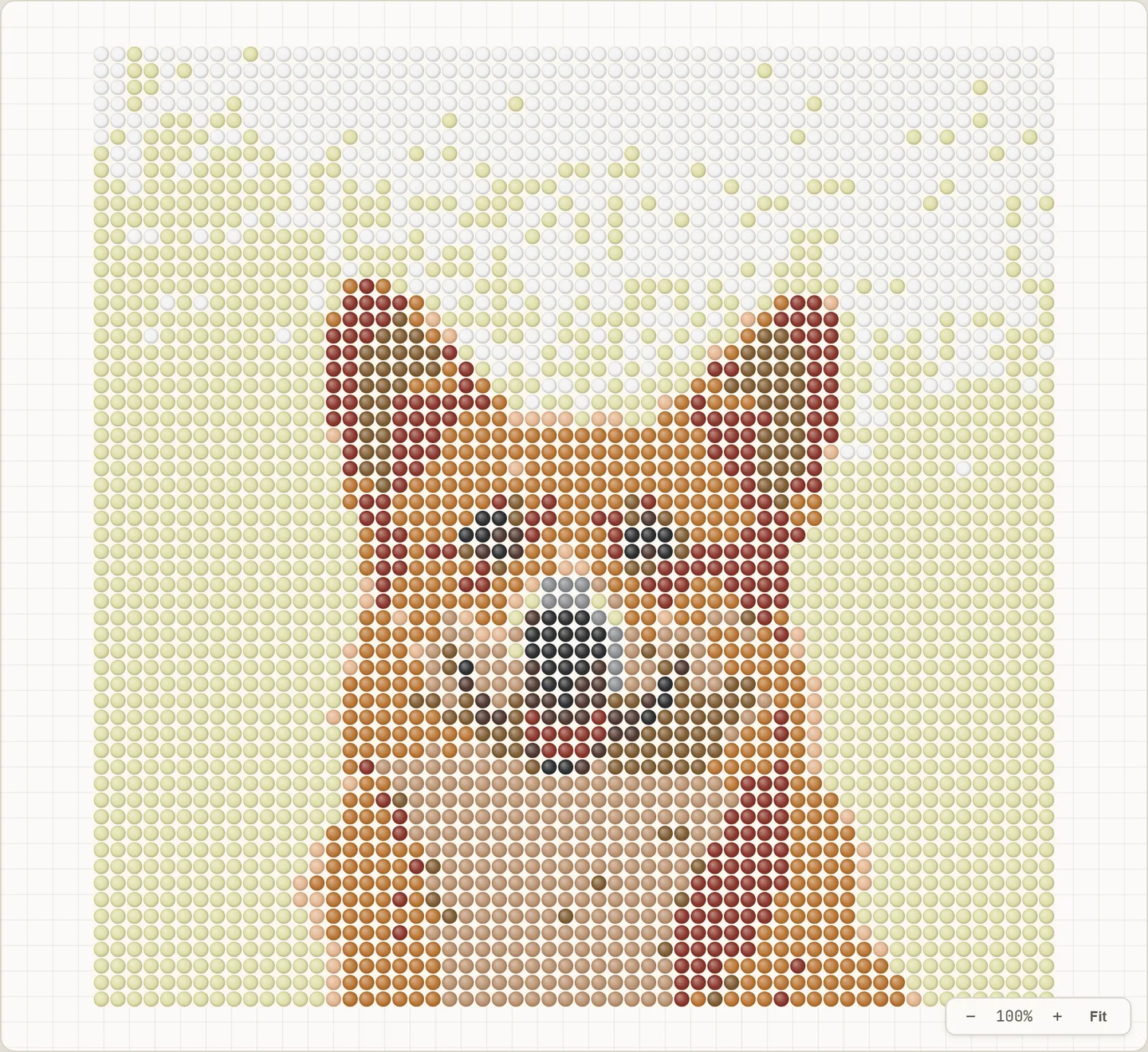
What each size costs you
Time scales with the bead count, not the board count. At a steady 250 to 300 beads an hour with your colors already sorted, a one-board piece runs roughly 45 to 90 minutes, and a 58×58 piece runs several hours.
If this is your first build, keep the session short. Sorting your beads before you start makes more difference than anything else you can do — it is the difference between a relaxed evening and a frustrating one. There is no prize for finishing a four-board piece in one go.
What decides how many beads a cell uses
Grid width sets how many positions the picture has. Color matching sets how many of those positions end up sharing a bead color. The Studio matches through CIEDE2000 in CIELAB space and dithers with Floyd–Steinberg, so a smooth sky becomes a scatter of two or three bead colors rather than a flat band — which is exactly why the same photo needs more colors at 58 wide than it does at 29.
If you want to see how the numbers work before committing to a board count, the pattern library lists the exact bead count and color count for every chart.
Questions
How many beads fit on a pegboard?
A standard 29×29 square board holds 841 beads. A 2×2 layout of four interlocked boards gives 58×58 and 3,364 beads. A 3×3 gives 7,569 and a 4×4 gives 13,456.
What size board do I need for a photo pattern?
29 for one board, 58 for a recognizable portrait, 87 if you want fur and facial detail to read properly. Doubling both dimensions gives four times the positions, so a tighter crop often beats a bigger board.
Do I need four separate boards for a 58×58 pattern?
You need four boards interlocked in a 2×2 layout. They connect to each other, and Perler, Hama and Artkal boards all connect to each other, so a mixed set works.
How many beads should I actually buy?
Use the per-color count on the pattern rather than the board maximum, then add 10 to 20 percent as spares. Black, white, cream, tan and neutral grey run out first in almost every pattern.
How long does a pattern take?
At 250 to 300 beads an hour, a one-board pattern is about 45 to 90 minutes and a 58×58 pattern is several hours. Sorting your colors first is the biggest factor in whether that feels fast.
Can I use a bigger picture frame than my board?
You can, but measure the actual board rather than trusting the nominal size — product families differ slightly in edge spacing and connector geometry. A finished piece also shrinks slightly when it cools.