Advanced build
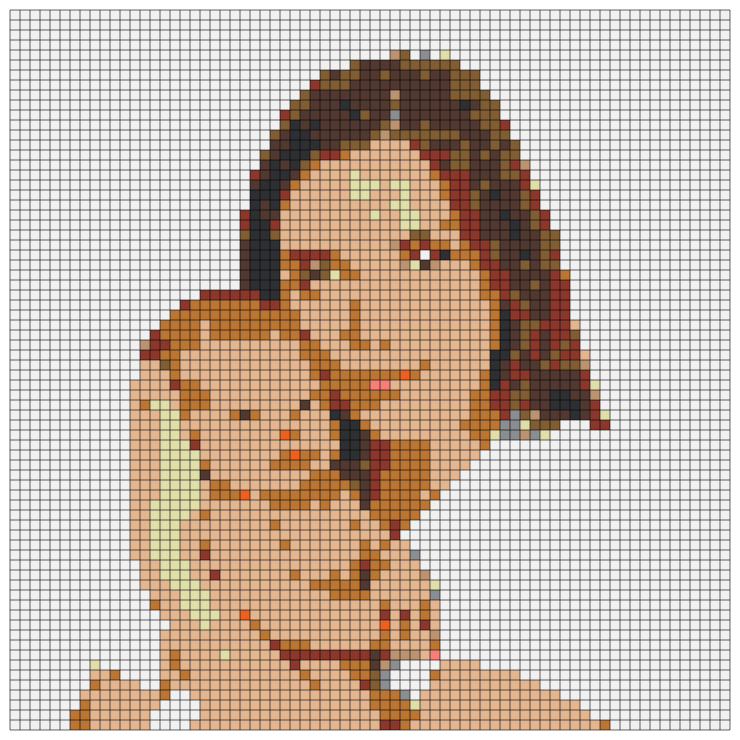
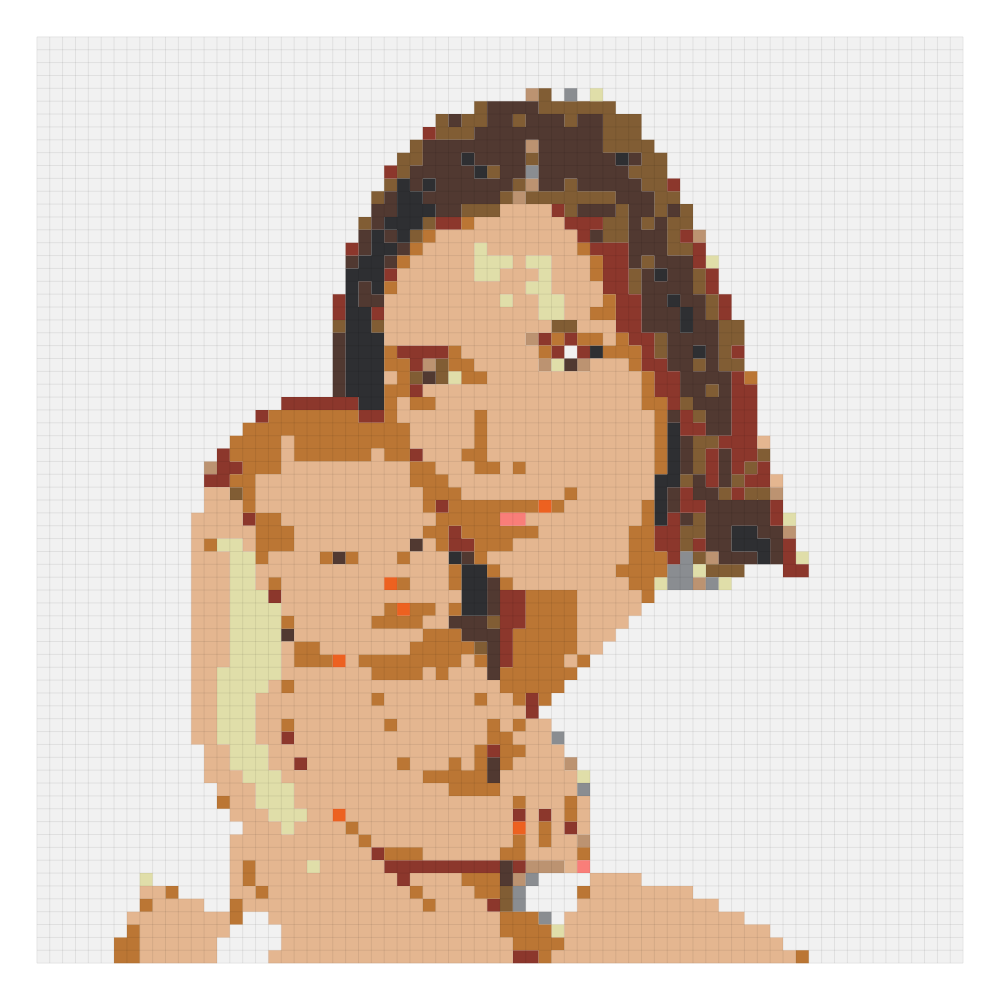
Newborn With Parent Perler bead pattern
A parent holding a newborn. The soft, low-contrast scene is the hard kind of photo for beads — useful as a "what to skip" reference.
- Grid
- 72 × 72
- Colors
- 12
- Beads needed
- 5,184
- Boards
- 9 boards, 72×72
- Build time
- 17½–21 hours
- Color card
- Perler
The full chart is above, at actual size. Printing it, or exporting it as a PDF with a shopping list, is a separate step in the Studio — you do not need either to build from this page.
Colors and bead counts
Sorted by how many of each you will need, so the biggest pile goes down first. Codes are Perler codes.
| Color swatch | Code | Color | Beads |
|---|---|---|---|
| P01 | White | 2,976 | |
| P98 | Sand | 1,163 | |
| P85 | Gold | 325 | |
| P12 | Brown | 225 | |
| P20 | Rust | 152 | |
| P21 | Light Brown | 124 | |
| P02 | Cream | 100 | |
| P18 | Black | 76 | |
| P35 | Tan | 20 | |
| P17 | Grey | 14 | |
| P04 | Orange | 6 | |
| P100 | Pearl Coral | 3 | |
| Total | 5,184 | ||
Buy a little extra White — at 2,976 beads it is the deepest pile on this chart, and it is the shade you run out of first if you sort a few early. A handful of spares covers the bead that slips under the pegboard.
Building it
This is an advanced build — 5,184 beads across 12 colors. Budget an afternoon, sort every color before you start, and do not leave it half-placed overnight.
- Sort the piles. 12 colors is a lot to juggle. Start with the three big piles: White (2,976), Sand (1,163) and Gold (325) — those three alone cover 86% of the build. Label every tray with its code from the table above.
- Start where it matters. Start at the faces and hands and work outward. On a 72×72 9-board layout, getting the faces and hands right first means the rest of the pattern has a fixed reference to line up against.
- Iron with parchment. Parchment paper, never wax paper. Perler beads fuse clean on medium heat around 150 to 170°C, steam off, slow circles. Lift after 10 seconds: holes should just start to close. The rare colors here — Tan (20), Grey (14), Orange (6) — are the ones most likely to melt unevenly if the iron sits too long, so hover over those spots rather than pressing.
- Flip and fuse the back. Flip the whole 9-board assembly and iron the back. A 5,184-bead wall piece needs both sides fused or it will flex and crack at the board seams.
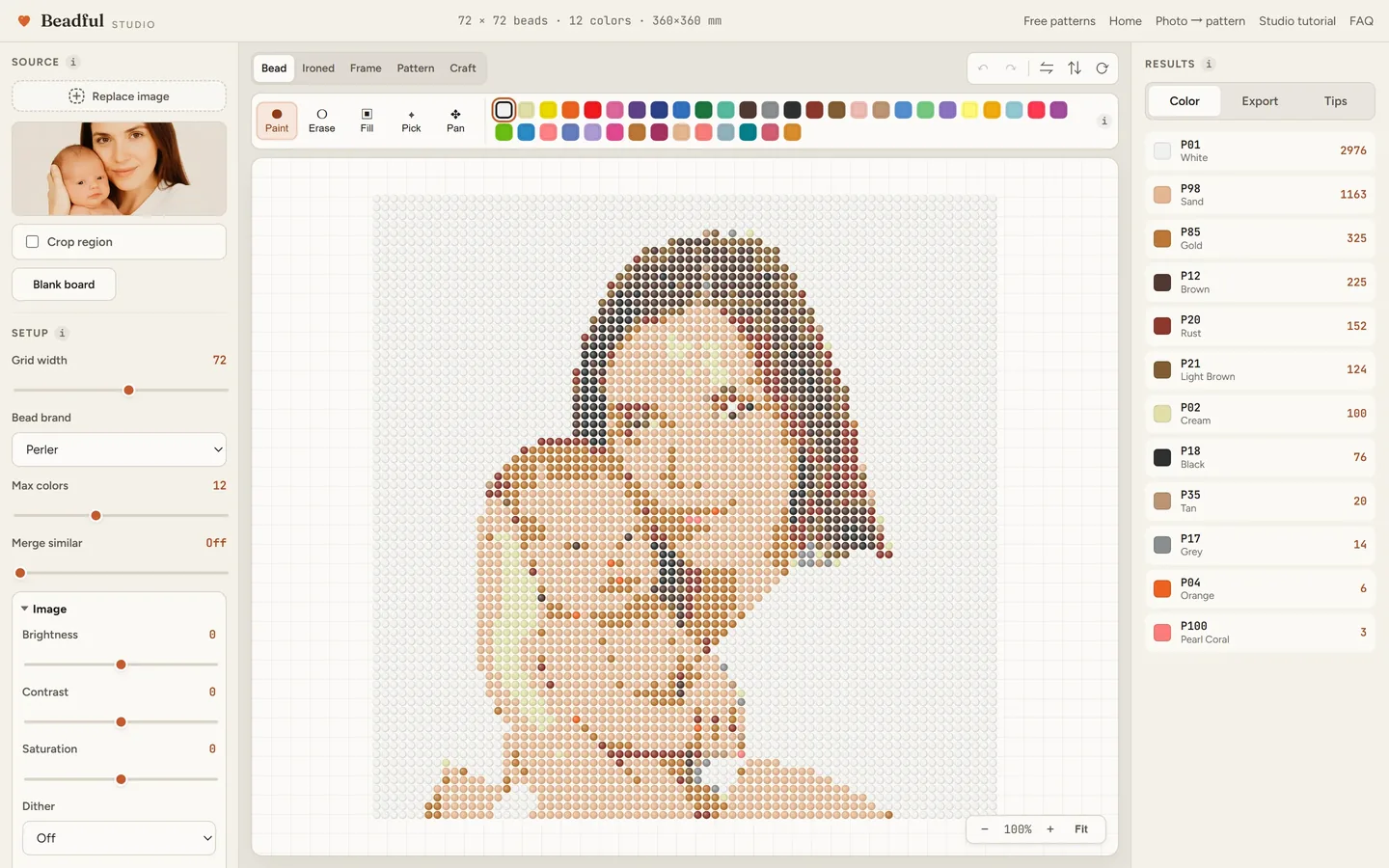
- Finish it. Cool flat under books for 5 minutes, then mount. A 72×72 piece looks best framed — the Studio preview above shows it in a frame. If hanging, a small D-ring at each board corner keeps it level.
How this chart was color-matched
The photo was matched to real Perler beads using the CIEDE2000 formula in CIELAB space, then dithered with Floyd–Steinberg so gradients break into a bead pattern instead of banding. Plain RGB distance fails badly on skin tones and pale shadows, which is where most photo converters give you a flat beige face. Everything here was produced by the Beadful Studio converter — the same tool you can point at your own photo.
How the 9 boards come together
12 colors across 9 boards is where the pile of sorted tray rows really pays off: group the colors into two trays by quadrant, so the 12 shades never have to cross the whole workbench in one sweep. The seam between boards is the one place a large piece fails, so before you iron, press each board's edge against the next until the pegs click, then run your thumb along the join. Perler beads sit a touch loose in the pegs, so press each quadrant down with a fingertip as you place.
Questions about this pattern
How many beads do I need for the newborn with parent pattern?
5,184 beads in 12 colors. That fills the 72 by 72 grid almost completely, because the background is converted along with the subject. A standard 29 by 29 pegboard holds 841 beads and a 72 by 72 9-board layout holds 5,184.
Do I need a specific bead brand?
No. This chart was generated on the Perler color card, but every 5mm fuse bead brand — Perler, Hama, Artkal, MARD, Nabbi — fits the same grid, and the square boards interlock across brands. Match by color rather than by code, because Perler P01 and Hama H01 are both white but not the same white.
Which pegboard do I need?
Nine 29×29 boards interlocked in a 3×3 layout, giving a 72 by 72 grid. Any standard 5mm square board works, including mixed brands.
How long does it take to make?
Roughly 17½ to 21 hours of placement at 250 to 300 beads an hour, plus ironing. The larger versions are several hours of work. If this is your first build, do one board in a single session and leave the multi-board pieces for later.
What ironing settings should I use?
Parchment paper rather than wax paper, a dry iron on medium heat around 150 to 170°C, steam off, moved in slow circles. Check after about 10 seconds: the holes should begin to close but still be visible. Fusing both sides gives a sturdier result. Cool it flat under books for five minutes.
Can I change the size?
Yes, and you will need to if your board does not match. Load the photo in the Studio and set the grid width to 29, 58 or 64 — the converter will rebuild the pattern against that grid and recalculate the color list. The slider accepts any value from 16 to 120.
Are these patterns free to use?
Yes. Viewing the chart and building from it is free. You do not need an account to look at any pattern on this page.
Other patterns
Still deciding what to buy?
The bead size guide covers 5mm versus 2.6mm, the color guide explains what 72 and 168 colors really give you, and the board size guide lists every pegboard layout with its bead count and build time.